
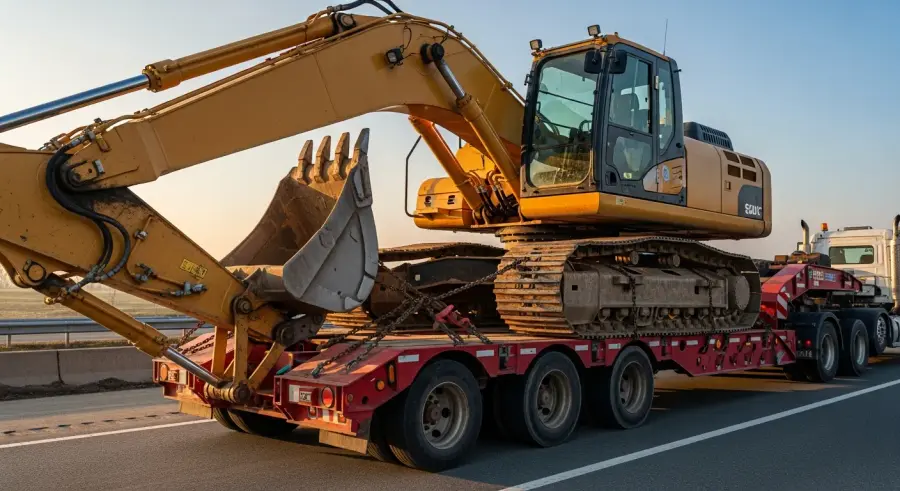
Flat Rack and Open Top Container Transport
Sizes, Weight Limits, NY/NJ Terminal Out-of-Gauge Rules and the Truck Leg Out of the Port
Quick answer
When does cargo need a flat rack or an open top container?
Use an open top when cargo is too tall for a closed box or must be lowered in by crane: a 40 ft open top carries 28,500 kg (62,832 lb). Use a flat rack when cargo is wider or heavier: a 40 ft high-cube rack is rated for up to 54,200 kg (119,490 lb). A load wider than 8 ft 6 in needs a permit for the road leg.
Updated October 2026 by the HTS Logistics broker team (FMCSA MC# 1178470).
Flat rack, open top or platform: which one fits the cargo?
Width and weight decide it. NY/NJ terminal tariffs class all three as special equipment with half the free time of a dry box, which is why we handle them as their own part of our port drayage in New York and New Jersey. The type is printed in the ISO size-type code on the box: a P means a flat rack or platform, a U means an open top.
| Container | Use it when | What to know |
|---|---|---|
| Open top22U1, 42U1, 45U1 | The cargo fits the box's 2.35 m (7 ft 8½ in) inside width but is too tall for a closed container, or has to be lowered in by crane or hung from overhead tackle through the doors. | Roof bows and the tarpaulin come off and the door header swings out. Lashing points hold 1,000 kg (2,205 lb) each. The 40 ft high-cube version adds 305 mm (1 ft) of inside height. |
| Flat rack22P3, 45P3 | The cargo is wider than a container, heavier than a closed box can carry, or has to be lifted on and off from the side. | Collapsible end walls, lashing points rated 5,000 kg (11,023 lb) each, no stanchions unless ordered, and no welding. Full payload counts only when the weight is spread over the whole floor (20 ft) or the full length of the side rails (40 ft). |
| Platformflat rack series, end walls folded | The cargo is longer than a rack's end walls allow, or a heavy load bears on a small area of the floor. | A 40 ft platform is rated as a foundation for breakbulk up to 85,000 kg (187,393 lb) of static load; it rides on a chassis like any flat rack. |
Rule of thumb from the tables below: if the piece fits inside about 2.35 m (7 ft 8½ in) of width and weighs under 28,000 kg, an open top usually works. Past either number, it is a flat rack; and a piece so large that no rack can take it ships as breakbulk.
Flat rack dimensions and weight limits
Hapag-Lloyd's published figures for its two flat rack types. Inside height runs from the floor to the top of the corner posts; the deck is the height of the rack's floor structure, which sits on top of the chassis. Weights vary by series, so the ranges cover every series listed.
| Flat rack | Length between corner posts | Width between corner posts | Inside height | Deck | Max gross | Tare | Max payload |
|---|---|---|---|---|---|---|---|
| 20 ft flat rack22P3, 8 ft 6 in high | 5,612 mm (18 ft 5 in) | 2,227 mm (7 ft 3¾ in) | 2,219 mm (7 ft 3¼ in) | 370 mm (1 ft 2½ in) | 34,000–45,000 kg (74,957–99,208 lb) | 2,740–2,940 kg (6,041–6,482 lb) | 31,260–42,100 kg (68,916–92,815 lb) |
| 40 ft high-cube flat rack45P3, 9 ft 6 in high | 11,652 mm (38 ft 2¾ in) | 2,148–2,226 mm (7 ft ½ in to 7 ft 3¾ in) | 2,248–2,264 mm (7 ft 4½ in to 7 ft 5¼ in) | 648 mm (2 ft 1½ in) | 50,000–60,000 kg (110,231–132,277 lb) | 5,800–5,950 kg (12,787–13,117 lb) | 44,050–54,200 kg (97,114–119,490 lb) |
Source: Hapag-Lloyd Container Specification (edition 03/2016). Feet and pounds converted from the metric figures (1 kg = 2.20462 lb). Other ocean lines' racks differ by a few millimetres and kilograms; ask the line for the exact series on your booking.
Two details change what a rack can really carry. First, the rated payload holds only when the weight is spread over the floor; a short, heavy piece gets a lower rating, and the 40 ft rack requires heavy cargo to rest on its main girder. Second, 40 ft high-cube racks have a gooseneck tunnel at both ends so they can ride on a gooseneck chassis. Empty 20 ft racks fold and interlock seven to an 8 ft 6 in stack and 40 ft high-cube racks four; APM Terminals exempts these bundles of flat racks from TERMPoint appointments.
Open top container dimensions and weight limits
Open tops have two inside heights: at the side walls and in the middle under the roof bows. Cargo that sticks up past the walls ships with the bows off, which makes it out of gauge in height. The roof opening is smaller than the floor because of the top rails and the door header.
| Open top | Inside length | Inside width | Inside height, side / middle | Roof opening | Max gross | Max payload | Volume |
|---|---|---|---|---|---|---|---|
| 20 ft open top22U1 | 5,895 mm (19 ft 4 in) | 2,352 mm (7 ft 8½ in) | 2,344 / 2,378 mm (7 ft 8¼ in / 7 ft 9½ in) | 5,418 × 2,232 mm (17 ft 9¼ in × 7 ft 3¾ in) | 32,500 kg (71,650 lb) | 30,200 kg (66,580 lb) | 32.5 m³ |
| 40 ft open top42U1 | 12,029 mm (39 ft 5½ in) | 2,350 mm (7 ft 8½ in) | 2,344 / 2,380 mm (7 ft 8¼ in / 7 ft 9¾ in) | 11,552 × 2,232 mm (37 ft 10¾ in × 7 ft 3¾ in) | 32,500 kg (71,650 lb) | 28,500 kg (62,832 lb) | 66.3 m³ |
| 40 ft high-cube open top45U1 | 12,029 mm (39 ft 5½ in) | 2,352 mm (7 ft 8½ in) | 2,649 / 2,683 mm (8 ft 8¼ in / 8 ft 9¾ in) | 11,552 × 2,192 mm (37 ft 10¾ in × 7 ft 2¼ in) | 32,500 kg (71,650 lb) | 28,250 kg (62,281 lb) | 74.9 m³ |
Steel-floor series as published by Hapag-Lloyd; wooden-floor series differ slightly, and one older 40 ft series is rated 30,480 kg (67,197 lb) gross. Standard open tops are 8 ft 6 in tall outside, high-cube open tops 9 ft 6 in.
Platforms are flat racks with the end walls folded down: a 20 ft platform is 6,058 × 2,438 mm (20 ft × 8 ft) with a 370 mm deck and the same 31,260–42,100 kg (68,916–92,815 lb) payload range as the 20 ft rack. Use one when the cargo is longer than the end walls allow.
Why a loaded flat rack becomes a permitted truck move
A container's rating and the road's limit are different numbers. A 20 ft flat rack rated 45,000 kg gross weighs 99,208 lb at full rating, more than the 80,000 lb New Jersey allows for the whole truck without a permit; a 40 ft high-cube rack at 60,000 kg is 132,277 lb. The legal cargo weight is whatever is left of 80,000 lb after the tractor, the chassis and the rack's own 2,740–5,950 kg (6,041–13,117 lb) tare.
- Width. Maher measures OOG width including lashing and blocking, and the road does too. Over 8 ft 6 in needs a New Jersey oversize permit; over 14 ft adds one escort; over 16 ft adds a second escort and a route survey (N.J.A.C. 13:18-1.12 and NJDOT's SUPERLOAD bulletin).
- Height. Add the chassis deck, the rack's deck (370 mm, 1 ft 2½ in, on a 20 ft rack; 648 mm, 2 ft 1½ in, on a 40 ft high-cube) and the cargo. Over 13 ft 6 in needs a permit; over 14 ft in New Jersey the permit holder must notify utilities, NJDOT and local traffic offices before the move, and over 14 ft 6 in needs a route survey.
- Weight. The annual ocean-borne container permit that lets sealed boxes run at 90,000 lb does not cover a flat rack with oversize cargo: N.J.A.C. 13:18-1.2(c) limits it to sealed containers and says it is not valid for oversize loads. Overweight or over-wide racks move on single-trip permits.
- Inside the port. Port Authority terminal roads allow 128,000 lb, but anything over 16 ft 3 in high or 11 ft wide needs approval from the Port Authority's Manager, Marine Terminals (PA-10 subrule 34-046), on top of the terminal's own OOG process.
- The Turnpike. NJDOT permits are not valid on the New Jersey Turnpike without the Turnpike Authority's approval (N.J.A.C. 13:18-1.9), and APM's gate is under a mile from Turnpike Exit 13A, so a permitted load leaving APM needs either the Authority's approval or a route that avoids the Turnpike.
- Port Street. Since August 3, 2026, Port Street at Port Newark is one 11 ft lane each way between Brewster Road and Marlin Street. Eastbound oversize loads use the Corbin Street ramp, westbound loads take the Marlin and Kellogg Street detour or Outer Port Street, every oversize load exits south via North Avenue, and a Port Authority Police escort is required (973-578-2180).
New Jersey prices single-trip permits from a $10 base ($20 when a load is both oversize and overweight), plus surcharges by the foot and by 2,000 lb, a $12 transaction fee and a 5% service charge; the full schedule and escort rules are in our New Jersey oversize permit fees and escort rules.
How each NY/NJ terminal handles flat racks and open tops
Every terminal gives flat racks, platforms and open tops 2 free days instead of 4, and demurrage on them starts at $459 a day under the NYTC tariff and $426 at Maher, so the out-of-gauge window has to be booked before the box is discharged. Our guide to demurrage on flat racks and open tops shows how the tiers add up. Gate hours and appointments for regular boxes are in our terminal-by-terminal gate and appointment rules.
| Terminal | OOG window | How it is booked | Rules and fees |
|---|---|---|---|
| Maher Terminals | Crane lifts by appointment; fees paid by 11 AM the business day before | [email protected] | Straddle carriers take pieces centered on the rack, under 11 ft wide including lashing and blocking, and under 88,000 lb. Larger pieces need a container-crane lift: $5,513.89 for one lift, $4,057.42 each for two picks, $3,170.38 each for five, done the same day within four hours. Maher never unloads a rack or open top: the whole unit goes to the driver. |
| APM Terminals Elizabeth | Weekdays; out-of-gauge loads cut off at 3:30 PM; none on weekend gates | Heavy Lift Department, 908-558-6374; no TERMPoint appointment needed | APM routes over-wide racks out through its Tripoli Street heavy-lift gate. The NYTC swing fee of $901.43 applies when cargo is moved between a rack and a trucker's own trailer. |
| PNCT | Wednesdays 8 AM–3 PM as posted in October 2026 (the day has changed in past notices) | All OOG charges paid before the truck arrives | NYTC swing fee $901.43 per occurrence. |
| Port Liberty Bayonne | Published four different ways on the terminal's and the Port Authority's pages; confirmed when the move is booked | [email protected] with a description, length × width × height, weight in pounds, photos showing the center of gravity, and lifting points | Stripping by appointment only. Swing fee $901.43 from October 5, 2026, paid online before the driver arrives (no payment from drivers). Flat rack free time 2 days. |
| Port Liberty New York | Mondays and Wednesdays, by appointment | [email protected]; paid before arrival | NYTC swing fee $901.43 per occurrence. |
| Red Hook | No out-of-gauge schedule published | Brooklyn 718-875-0777; Port Newark 973-522-0999 | Handles break-bulk, heavy-lift and project cargo at its Brooklyn and Port Newark terminals. |
Checked October 2026 on each terminal's pages and the two tariffs (NYTC effective October 5, 2026; Maher crane-lift rates effective October 1, 2026). The swing fee is the NYTC charge for switching out-of-gauge cargo to or from a flatbed or trucker-owned equipment.
Two ways to get the cargo out of the port
OPTION 1
Pull the whole rack on a chassis
A UIIA drayage carrier pulls the loaded rack on a chassis that fits it (see gooseneck and tri-axle chassis), the cargo is lifted off at your site or at a yard with a crane, and the folded rack goes back to the line's return location. Per diem runs on the rack until it is back. This is the only option at Maher, which releases the whole unit.
OPTION 2
Strip the cargo at the terminal
Under the NYTC tariff used by APM, PNCT, both Port Liberty terminals and Red Hook, the terminal can lift the cargo off the rack onto a trucker's own trailer for $901.43 per occurrence, by appointment and prepaid. The rack never leaves the terminal, so there is no empty to return, and the cargo leaves as a heavy-haul load with its own permits.
Decision rule: strip at the terminal when the piece would be over-height sitting on a rack and a chassis, or when the delivery site has no way to lift it; pull the rack when the site can lift it and is close enough to return the rack quickly. For a stripped piece, the usual trailer is an RGN (removable gooseneck) trailer: RGN decks run 14–24 in high loaded in manufacturer specifications (Trail King TKHD-S at 14 in, Fontaine Magnitude 75 at 24 in), which leaves 11 ft 6 in to 12 ft 4 in for cargo under 13 ft 6 in. We book that carrier and its permits the same way we handle other oversize loads leaving the port on RGN and step deck trailers.
A machine that ships without a container, rolled on a Ro-Ro vessel or lifted as breakbulk, skips the rack entirely; that pickup is covered under Ro-Ro and breakbulk machinery pickup.
Flat rack and open top questions
What is a flat rack shipping container?
A container with a floor and two end walls but no sides or roof, used for cargo that is too wide, too heavy or awkward for a closed box. Hapag-Lloyd's 40 ft high-cube flat rack measures 11,652 mm (38 ft 2¾ in) between its corner posts and is rated for 44,050–54,200 kg (97,114–119,490 lb) of cargo depending on the series. The end walls fold flat when the rack travels empty.
What is the height of a flat rack?
A 20 ft flat rack stands 8 ft 6 in high overall, with 2,219 mm (7 ft 3¼ in) from the floor to the top of the corner posts and a 370 mm (1 ft 2½ in) deck. A 40 ft high-cube rack stands 9 ft 6 in, with 2,248–2,264 mm inside and a 648 mm (2 ft 1½ in) deck. Cargo may stand taller than the posts; that is what makes it out of gauge.
What is the maximum weight for a 40 ft open top container?
Hapag-Lloyd rates its 40 ft open top at 32,500 kg (71,650 lb) gross, which leaves 28,500 kg (62,832 lb) for cargo after the 4,000 kg box. One older wooden-floor series is rated 30,480 kg (67,197 lb) gross. On the road, the whole truck is still held to 80,000 lb in New Jersey without a permit.
What is considered out-of-gauge cargo?
Cargo that sticks out past the container's frame in length, width or height while still shipping on a flat rack or in an open top. APM Terminals defines it that way and treats cargo too large even for that as breakbulk. At the terminal, OOG means its own window, prepaid fees and often a crane lift; on the road, anything over 8 ft 6 in wide or 13 ft 6 in high needs a permit.
Can a flatbed carry a shipping container?
Containers normally leave NY/NJ terminals on a chassis, locked at the corners with twist locks. What a flatbed or RGN usually takes is the cargo: under the NYTC tariff, the five terminals other than Maher can lift out-of-gauge cargo off a flat rack onto a trucker's own trailer for $901.43 per occurrence, by appointment and prepaid. Maher does not do this; it releases only the whole rack. The NYTC chassis change or box on/off charge is $189.78.
Does the New Jersey annual container permit cover a heavy flat rack?
No. N.J.A.C. 13:18-1.2(c) limits the annual ocean-borne containerized cargo permit to sealed containers, up to 90,000 lb gross, and says it is not valid for oversize loads. A flat rack carrying over-wide or overweight cargo moves on New Jersey single-trip permits instead, with escorts once the load passes 14 ft wide and a route survey past 16 ft wide or 14 ft 6 in high.
Sources
Facts on this page were checked in October 2026 against the sources below. Rules and rates change; we confirm current requirements on every move.
- Hapag-Lloyd Container Specification (edition 03/2016) (flat rack, open top and platform tables; downloaded Oct 2026)
- Maher Terminals: OOG cargo handling and crane lifts
- Maher Terminals Schedule No. 010599 (container-crane lift rates, demurrage) (October 1, 2026 (demurrage rates effective May 5, 2025))
- New York Terminal Conference Schedule No. 011408 (OOG switching fee, demurrage, chassis change) (effective October 5, 2026)
- APM Terminals Elizabeth: break bulk and OOG
- APM Terminals Elizabeth: hours of operation (OOG cutoff)
- APM Terminals Elizabeth: driver information (Tripoli Street heavy-lift gate)
- APM Terminals Elizabeth: TERMPoint user guide and FAQs (January 2025)
- PNCT: gate hours (heavy lift and OOG lifts)
- Port Liberty Bayonne: carriers and truckers (OOG requests, flat rack free time)
- Port Liberty Bayonne: home page alerts (swing fee from Oct 5, 2026)
- Port Liberty New York: terminal details (OOG days)
- Red Hook Terminals
- Port Authority Marine Terminal Tariff FMC Schedule PA-10, subrule 34-046 (effective May 1, 2026)
- N.J.A.C. 13:18 (annual container permit, single-trip permits, fees, escorts)
- NJDOT SUPERLOAD permit system and bulletins (route surveys; Port Street restriction from Aug 3, 2026)
- N.J.S.A. 39:3-84, vehicle size and weight limits
- Trail King: TKHD-S one-pager (14 in loaded deck height)
- Fontaine Specialized: Magnitude 75 MFLD (24 in loaded deck height)
Moving a flat rack or open top out of the port?
Send the container number, terminal, last free day and the cargo's length, width, height and weight with photos and lifting points. We check the terminal's OOG window and fees, then quote the dray, the strip or crane lift, and any permitted truck leg.
- FMCSA-licensed property broker, MC# 1178470
- Drayage carriers with UIIA interchange and NY/NJ port credentials
- Pickups planned around terminal appointments and free time
- Importers, exporters, forwarders and customs brokers
Prefer to talk? Call (631) 683-8275.
Request a Commercial Quote
Keep reading
- Container Drayage (NY/NJ)Container drayage from the six NY/NJ terminals to Long Island, NYC and New Jersey, booked with credentialed UIIA carriers.
- What Is Drayage?What drayage means, its types, a NY/NJ import dray step by step, and the charges on a dray invoice.
- Port of NY & NJ TerminalsGate hours, appointments, free time, tariffs, credentials and weight limits at all six NY/NJ container terminals, checked October 2026.
- Ro-Ro & Breakbulk MachineryImported machinery picked up at the port, with 2025 import data by U.S. port.
- Demurrage vs DetentionFMC definitions, NY/NJ free time and daily rates, per diem rules and how to dispute a bill.
- Container Chassis GuideChassis types, TRAC, DCLI and Flexi-Van pools and rates, chassis splits, UIIA insurance and tri-axles for heavy boxes.